

When you start the process of ordering custom lapel pins, one question comes up more than almost any other: should I go with soft enamel or hard enamel?
It’s a fair question. The two finishes look similar in photographs, carry similar price tags, and are both produced by the same general manufacturing process. But they feel different in the hand, wear differently over time, and suit different applications. Choosing the wrong one for your brief isn’t a disaster — but choosing the right one from the start means a better result for your club, business or organisation.
In this guide we walk through exactly what separates soft enamel from hard enamel lapel pins, when each is the better choice, and where die-struck metal fits in as a third option worth considering.
How Lapel Pins Are Made: The Shared Starting Point
Soft enamel and hard enamel pins both start the same way. A steel die is cut to the shape of your design — your club crest, company logo, or custom artwork. That die is used to stamp your design into a metal blank (typically zinc alloy or brass), creating raised borders and recessed areas that mirror your artwork in three dimensions.
Once the stamped metal blank is cleaned and plated — in gold, silver, antique gold, or whatever finish you’ve specified — the process splits into two different paths depending on whether you’ve ordered soft enamel or hard enamel.
Soft Enamel Lapel Pins
How they’re made
In soft enamel production, coloured enamel paint is applied by hand into the recessed areas of the stamped metal blank. The pin is then baked at a relatively low temperature to cure the enamel. Crucially, the enamel is not polished down to the level of the raised metal borders — it sits slightly below them.
What they look and feel like
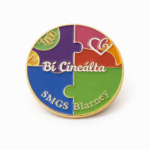
Run your finger across a soft enamel pin and you’ll feel the raised metal borders standing proud of the coloured enamel fill. The surface is textured and three-dimensional. Hold it to the light and the raised borders catch it differently from the recessed colour areas, giving the design a depth and visual interest that a flat surface cannot replicate.
The enamel colours in soft enamel pins tend to be vivid and bold. Because the enamel is not polished, it retains a slightly satin rather than glassy appearance.
Durability
Soft enamel pins are durable for everyday use. The enamel fill can chip if the pin is knocked hard against a sharp edge repeatedly over years of wear — but for the vast majority of applications (corporate wear, club merchandise, event giveaways, school badges), this is not a practical concern. Hundreds of thousands of soft enamel pins are produced globally every year and worn daily without issue.
Cost
Soft enamel is the more affordable of the two enamel options. The manufacturing process is shorter — no grinding, no polishing stage — which reduces production time and cost per unit. For most budgets, soft enamel offers excellent quality at a price that makes the order viable.
Hard Enamel (Cloisonné) Lapel Pins
How they’re made
Hard enamel — also called cloisonné — takes the same stamped metal blank but applies the enamel in multiple layers, firing it at high temperature between each layer. Once the enamel has been built up to the level of the raised metal borders, the entire surface is ground flat and then polished until the enamel and the metal are perfectly flush.
The result is a pin with a completely smooth, flat surface. Every element of the design — the coloured enamel and the metal borders — sits at exactly the same level, polished to a mirror shine.
What they look and feel like
Hard enamel pins feel substantial. They are heavier than soft enamel pins of the same size because the enamel layers are denser and more tightly packed. Run your finger across one and you feel a smooth, glassy surface with no variation in height — like a very small polished tile.
The metal borders are bright and reflective. The enamel itself has a deep, glass-like quality rather than the satin finish of soft enamel. Under good light, a hard enamel pin has a jewellery-like presence.
Durability
Hard enamel pins are significantly more scratch-resistant than soft enamel. The grinding and polishing process hardens the enamel surface, and the flush finish means there are no raised edges to catch and chip. Hard enamel pins are routinely given as long-service awards and commemorative gifts precisely because they are expected to be kept and worn for decades.
Cost
Hard enamel costs more than soft enamel — typically 20–40% more per unit at comparable quantities. The multi-layer application, high-temperature firing, grinding and polishing stages add both time and labour to the production process. For formal awards and executive gifts, this premium is well justified. For high-volume club merchandise or event giveaways, soft enamel usually makes more financial sense.
Die-Struck Metal: The Third Option
Die-struck pins contain no enamel at all. The same stamping process creates the raised and recessed design in metal, but instead of filling the recesses with colour, the pin is polished, sandblasted or antiqued to bring out the relief. The result is a monochrome, all-metal pin with a classic, understated character.
Die-struck pins suit designs that work in a single metal tone — heraldic crests, monograms, club insignia, regimental-style badges. They have a formal, timeless quality that enamel pins, for all their colour, cannot quite replicate. They are also the most durable of the three options — with no enamel to chip or wear, a die-struck pin can last indefinitely.
If your design depends on specific colours to carry meaning — your club colours, your brand palette, your county colours — then enamel is the right choice. If your design is strong in silhouette and works in metal alone, die-struck is worth considering.
Soft Enamel vs Hard Enamel: Side-by-Side Comparison
| Soft Enamel | Hard Enamel | Die-Struck | |
|---|---|---|---|
| Surface | Textured, raised borders | Smooth, flush, polished | Metal only, no fill |
| Finish | Satin enamel, bold colour | Glassy enamel, deep colour | Polished, antique or sandblasted metal |
| Weight | Standard | Heavier (denser enamel) | Standard to heavy |
| Durability | Good | Excellent | Excellent |
| Relative cost | Lower | Higher (20–40% more) | Comparable to soft enamel |
| Best for | Club merchandise, events, schools, charities, high volume | Awards, executive gifts, long service, formal occasions | Crests, heraldic designs, military, formal insignia |
Which Should You Choose? A Practical Guide for Irish Organisations
GAA clubs and sports clubs
For club crest pins sold as merchandise, given as player gifts, or distributed at championship events, soft enamel is the standard choice. The colour reproduction is excellent for club crests, the price point makes bulk orders viable, and the textured surface gives the pin a tangible quality that members appreciate. We produce the majority of our GAA and sports club pins in soft enamel.
If your club is producing a limited commemorative edition — for a centenary, a county championship, or a retirement presentation — hard enamel is worth the additional cost. It signals that the pin is something to be kept, not just worn.
Corporate and professional organisations
For everyday staff pins, corporate event giveaways and branded merchandise, soft enamel delivers the right balance of quality and value. For long service awards, board-level recognition, executive gifts and formal presentations, hard enamel is the appropriate choice. The weight, smoothness and jewellery-like finish communicate the significance of the occasion in a way that soft enamel, for all its quality, does not quite match.
Schools and universities
School prefect pins, house leadership badges and achievement award pins are typically produced in soft enamel — cost-effective for the quantities schools order and durable enough for daily wear on a school uniform. For graduation commemoratives or special anniversary pins, hard enamel is a step up worth considering.
Charities and awareness campaigns
Flag-day pins, fundraising collectibles and campaign supporter badges are almost always soft enamel. The lower per-unit cost allows charities to produce pins at a price point that makes sense for donation-level merchandise. Colour vibrancy is excellent, which matters when the colour of the pin carries meaning (think ribbon colours for awareness campaigns).
Military, emergency services and formal insignia
For An Garda Síochána, Irish Defence Forces units, the Irish Coast Guard and similar organisations, die-struck or hard enamel are both appropriate — depending on whether colour is part of the design. Unit crests with specific colour elements suit hard enamel; monochrome regimental-style insignia suit die-struck. The premium finish communicates the formality and significance of the award or insignia.
The Short Answer
If you’re ordering pins for a sports club, school, charity or general promotional use — soft enamel is almost certainly the right choice. It offers excellent colour, a premium feel, and a price point that makes the order practical.
If you’re ordering pins for a formal awards programme, a long service presentation, a commemorative edition, or any occasion where the pin itself needs to communicate prestige — hard enamel is worth the additional investment.
If colour isn’t part of your design and your artwork works in a single metal tone — die-struck is a compelling option that many organisations overlook.
Not sure which is right for your brief? Contact the Abbey Badges team and we’ll advise based on your design, your budget and your end use — and send you a free digital mockup of your pin in whichever finish suits best.